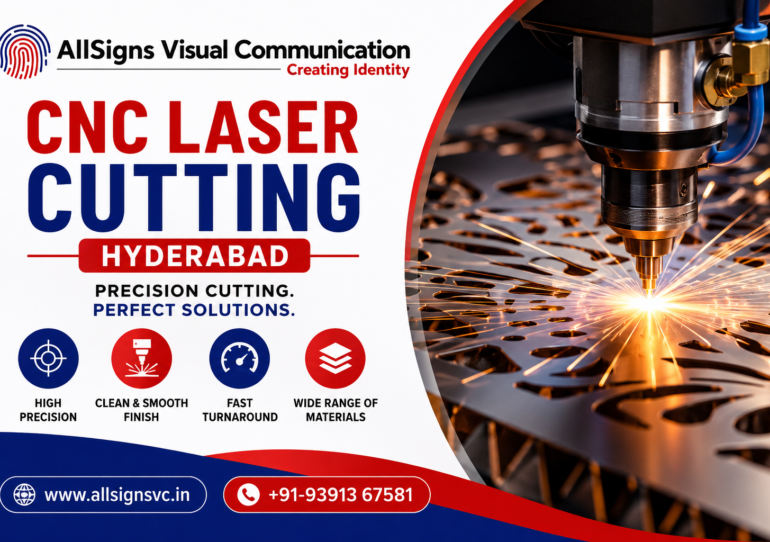
In today’s rapidly evolving manufacturing industry, accuracy, productivity, and cost efficiency are essential for achieving consistent results. Businesses require advanced fabrication technologies that can transform complex designs into high-quality components while minimizing errors and material waste. CNC Laser Cutting Hyderabad has emerged as an effective solution for manufacturers, engineers, fabricators, and designers looking for reliable cutting services for a wide variety of applications.
CNC laser cutting combines computer numerical control (CNC) technology with a focused laser beam to cut materials according to precise digital instructions. This automated process allows intricate designs, detailed profiles, and accurately dimensioned components to be produced with excellent repeatability. From sheet metal fabrication to customized industrial parts, CNC laser cutting supports a broad range of manufacturing requirements.
As Hyderabad continues to develop as a major center for engineering, infrastructure, electronics, and industrial production, the demand for advanced cutting solutions continues to grow. Understanding the benefits, applications, and selection criteria for CNC laser cutting can help businesses make informed decisions for their fabrication projects.
What Is CNC Laser Cutting?
CNC laser cutting is an automated manufacturing process in which a computer-controlled machine directs a concentrated laser beam onto a material to create specific shapes and dimensions. The cutting path is generally generated from a digital design prepared using computer-aided design (CAD) software.
The CNC system controls the movement of the cutting head and coordinates the cutting process according to programmed instructions. Depending on the machine and material, the laser may melt, vaporize, or otherwise remove material along the required cutting path.
Unlike conventional cutting techniques that depend on mechanical blades or physical contact, laser cutting uses concentrated energy to produce detailed profiles. This makes it suitable for intricate patterns, repeated components, and designs that require consistent dimensions.
Businesses searching for CNC laser cutting services in Hyderabad can explore this technology for industrial fabrication, metal components, architectural panels, electrical enclosures, equipment parts, and customized products.
Major Benefits of CNC Laser Cutting Hyderabad
- Exceptional Cutting Precision
Precision is one of the most important advantages of CNC laser cutting. Computer-controlled movements help the machine follow programmed designs accurately, making it possible to manufacture components with detailed shapes, narrow slots, and carefully positioned openings.
For engineering and manufacturing projects, this accuracy can simplify assembly and reduce dimensional inconsistencies. Actual tolerances depend on the machine, material thickness, design geometry, and operating conditions.
Choosing precision CNC laser cutting in Hyderabad can be particularly useful when a project requires repeatable dimensions and consistent production quality.
- Improved Production Efficiency
Automated cutting reduces the need for continuous manual intervention during the cutting stage. Once the design and machine parameters are prepared, the equipment can follow the programmed cutting path efficiently.
This helps manufacturers manage repetitive production tasks, reduce avoidable handling, and maintain a more organized workflow. The overall production time will depend on material thickness, cutting complexity, machine capacity, and order quantity.
- Consistent Results for Repeated Orders
Producing identical components is essential for many industrial applications. CNC technology allows digital cutting instructions to be reused, helping maintain consistency across multiple components and repeat orders.
This advantage is valuable for manufacturers producing brackets, mounting plates, enclosures, machine components, and other parts that must follow standardized dimensions.
- Better Material Utilization
Material costs can represent a significant portion of fabrication expenses. CNC laser cutting can be combined with nesting software to arrange multiple parts efficiently on a single sheet.
Optimized layouts help reduce unused spaces between components and may lower material wastage. The actual savings depend on component shapes, sheet dimensions, cutting clearances, and production planning.
- Greater Design Flexibility
Traditional manufacturing methods may require specialized tooling for particular shapes. CNC laser cutting can accommodate many design changes through updated digital files, reducing the need for dedicated cutting tools.
This flexibility supports customized products, prototypes, decorative metalwork, and complex engineering components. It also makes it easier to adapt designs as project requirements evolve.
Materials Suitable for CNC Laser Cutting
The material selection process depends on the laser source, machine configuration, material thickness, and desired finish. Commonly processed materials include:
- Mild steel: Widely used for industrial brackets, frames, machine parts, support plates, and fabrication components.
- Stainless steel: Suitable for equipment panels, enclosures, decorative elements, and components requiring corrosion resistance.
- Aluminium: Used for lightweight structures, selected automotive components, electrical housings, and engineering applications.
- Galvanized steel: Used in certain sheet metal fabrication projects when suitable equipment and safe processing procedures are available.
- Acrylic: Processed with compatible laser systems for signage, displays, decorative panels, and customized products.
- Wood and plywood: Used for decorative designs, models, crafts, and selected interior applications with appropriate laser equipment.
Not every CNC laser cutting machine can process all these materials. Therefore, confirming material compatibility, thickness capacity, dimensional requirements, and finishing expectations before production is essential.
Industrial Applications of CNC Laser Cutting Services
Manufacturing and Engineering
Manufacturing businesses use CNC laser cutting services to produce machine components, brackets, mounting plates, sheet metal panels, and precision-cut parts. Consistent dimensions can improve assembly efficiency and support repeatable manufacturing operations.
Automotive and Transportation
Laser-cut components are used in selected automotive fabrication projects, prototypes, mounting systems, brackets, and interior components. Each application must meet the appropriate material and engineering specifications.
Construction and Infrastructure
The construction sector uses laser-cut metal sheets for architectural screens, partitions, façade elements, railing inserts, and customized structural details. Complex patterns can combine practical functionality with attractive visual designs.
Electrical and Electronics
Electrical manufacturers often require control panel enclosures, equipment covers, mounting plates, and ventilation openings. CNC laser cutting can help create accurate profiles that support proper component alignment and assembly.
Furniture and Interior Design
Customized metal furniture, decorative partitions, display stands, and artistic panels can benefit from the design flexibility of laser cutting. Intricate shapes and patterns can be incorporated into products for commercial and residential interiors.
Industrial Machinery
Machine manufacturers may require accurately cut covers, guards, support plates, equipment housings, and replacement components. Digital programming makes it easier to reproduce suitable designs for recurring requirements.
How to Select the Right CNC Laser Cutting Service
Selecting an appropriate fabrication partner is important for achieving reliable quality, competitive costs, and timely delivery. Businesses looking for CNC laser cutting Hyderabad should evaluate several essential factors before confirming an order.
Machine capability: Verify whether the equipment supports your material type, thickness, sheet dimensions, and required design complexity.
Cutting accuracy: Discuss the dimensional tolerances and edge quality needed for the application. Components intended for assembly may require more stringent inspection.
Design support: Confirm which file formats are accepted, such as DXF and DWG, and whether drawing preparation or design corrections are available.
Material quality: Ensure the selected material grade and thickness meet the project’s engineering and performance requirements.
Quality control: Ask how finished parts are inspected and whether dimensional checks can be performed against the approved drawings.
Production capacity: Check whether the service can accommodate prototype work, small batches, or higher-volume manufacturing.
Delivery commitments: Discuss realistic production schedules, packaging, transportation, and any additional finishing operations.
Transparent pricing: Request a quotation that clearly identifies material costs, cutting charges, setup expenses, finishing work, and delivery fees.
Evaluating these factors helps businesses select a service that meets their technical requirements without overlooking important commercial considerations.
Factors Affecting CNC Laser Cutting Costs in Hyderabad
The price of CNC laser cutting services in Hyderabad depends on several variables. Material type and thickness influence cutting speed, machine settings, and processing requirements. Complex shapes may require longer cutting paths, while multiple small components may require additional programming or handling.
Order quantity also affects the cost per piece. Larger production runs may distribute setup expenses across more components, whereas smaller orders may have higher unit costs.
Other factors include sheet utilization, material availability, drawing complexity, finishing requirements, urgency, and transportation. Businesses can obtain more accurate estimates by providing detailed drawings, material specifications, thickness, quantity, and delivery expectations.
Comparing quotations based on identical specifications helps identify the most suitable option based on overall value, quality, and reliability rather than price alone.
The Future of CNC Laser Cutting Technology
The manufacturing sector is increasingly adopting automation, digital design tools, and advanced production planning. CNC laser cutting fits naturally into this transformation by connecting engineering drawings with automated fabrication processes.
Improvements in machine monitoring, cutting software, nesting technology, and workflow integration can help manufacturers increase productivity and improve resource utilization. In Hyderabad, demand from engineering, infrastructure, electronics, and industrial manufacturing creates opportunities for precision fabrication solutions.
Combining CNC laser cutting with bending, welding, machining, and assembly can further streamline production and support the manufacture of more complex products.
Conclusion
CNC Laser Cutting Hyderabad provides a modern approach to precision fabrication, combining computer-controlled automation with accurate material cutting. Its advantages include design flexibility, repeatable results, efficient production, and improved material utilization.
From industrial machinery and automotive components to architectural panels and customized products, this technology supports diverse manufacturing requirements. Selecting the right service involves assessing machine capabilities, material compatibility, quality standards, pricing, and delivery schedules.
By defining project specifications clearly and choosing suitable cutting methods, businesses can improve fabrication efficiency, maintain consistent component quality, and achieve dependable results. As industrial manufacturing continues to evolve, CNC laser cutting services in Hyderabad remain a valuable option for organizations seeking accuracy, flexibility, and productivity in modern fabrication.
